Home Apparel & Outdoor Pharma & Health Electronics & Battery ImpactInsights NewsContact 한국어
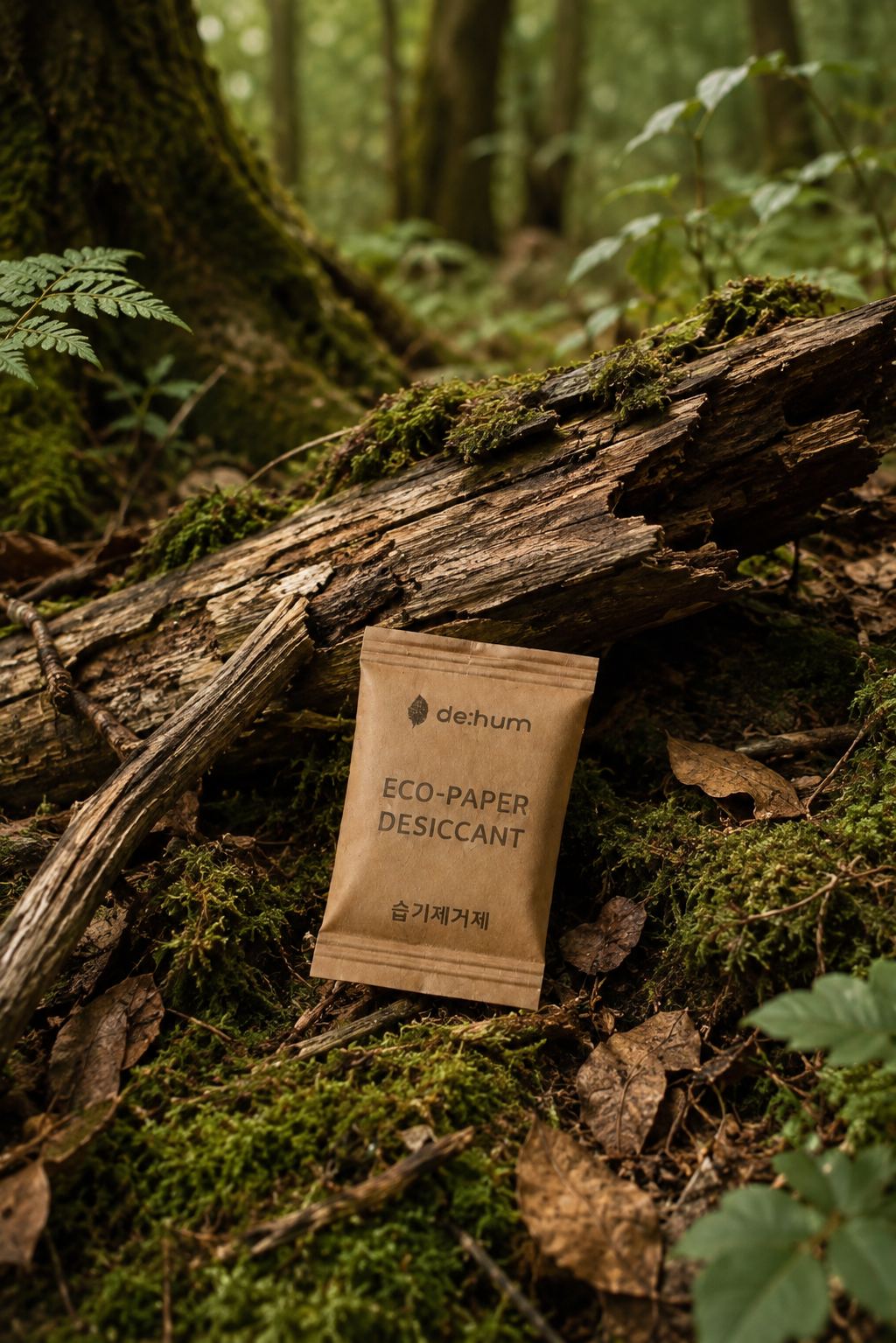
Paper-based eco desiccant

Control Moisture,
Naturally.

One sheet of paper controls moisture. ~4× the absorption of silica gel. Single-material recyclable.

Scroll
The problem

One desiccant,
one plastic sachet.
It doesn't have to be this way.

Most silica gel is sealed in plastic sachets and discarded with the product. Low absorption, high volume, and hard to recycle.

A brand's sustainability message and the plastic desiccant inside the packaging contradict each other.

Find your fit

Every industry has
a different moisture problem.

That's why desiccants need to change too. Select your industry to find the right product and application method.

01

Apparel & Outdoor

Apparel · Outdoor
See solution →
In development
02

Food

Food
See solution →
03

Pharma & Health

Pharma · Health
See solution →
04

Electronics & Battery

Electronics · Battery
See solution →
Trusted partners

Global brands choose de:hum.

From premium fashion to outdoor, 30+ brands that demand both performance and sustainability work with de:hum.

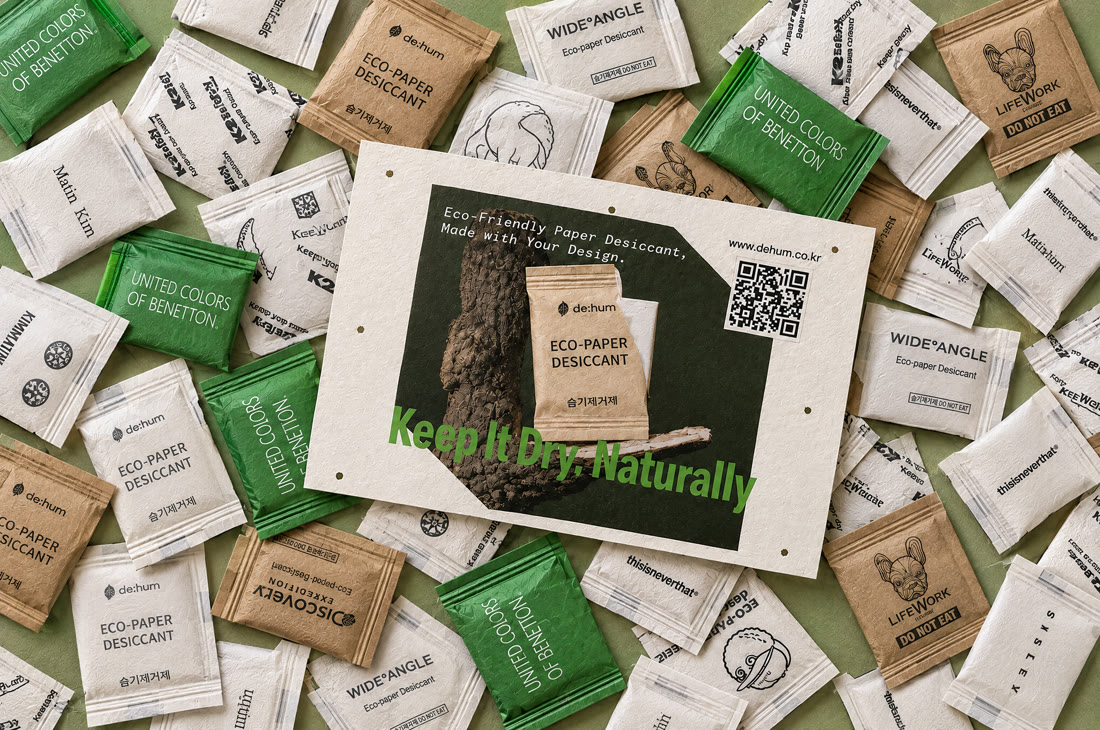
Partner logos: K2, EIDER, Discovery, DESCENTE, BLACK YAK, sisley, snow peak and more
de:hum Max Dry — sachets printed with customer brand logos

Keep It Dry, Naturally — eco-friendly paper desiccant with custom brand printing.

The technology

One paper absorption core,
one platform.

At de:hum's core is a cellulose-based paper absorption core. Kraft paper on the outside, white cellulose fiber inside — drawing in moisture.

This core is extended into sachets, sheets, and containers to meet industry-specific requirements.

  • Max DryAll-purpose sachet. Custom logo printing available
  • Smart DryTwo-way ERH control. Designed to a target humidity
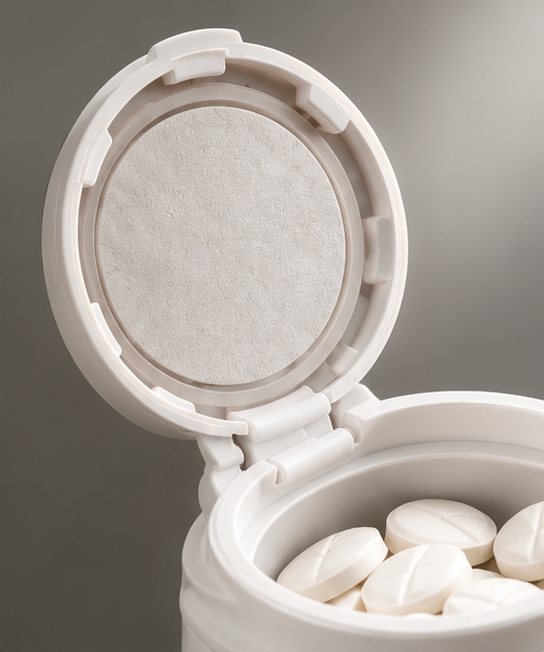
  • Cap DryDesiccant disc built into the lid. Holds a target humidity
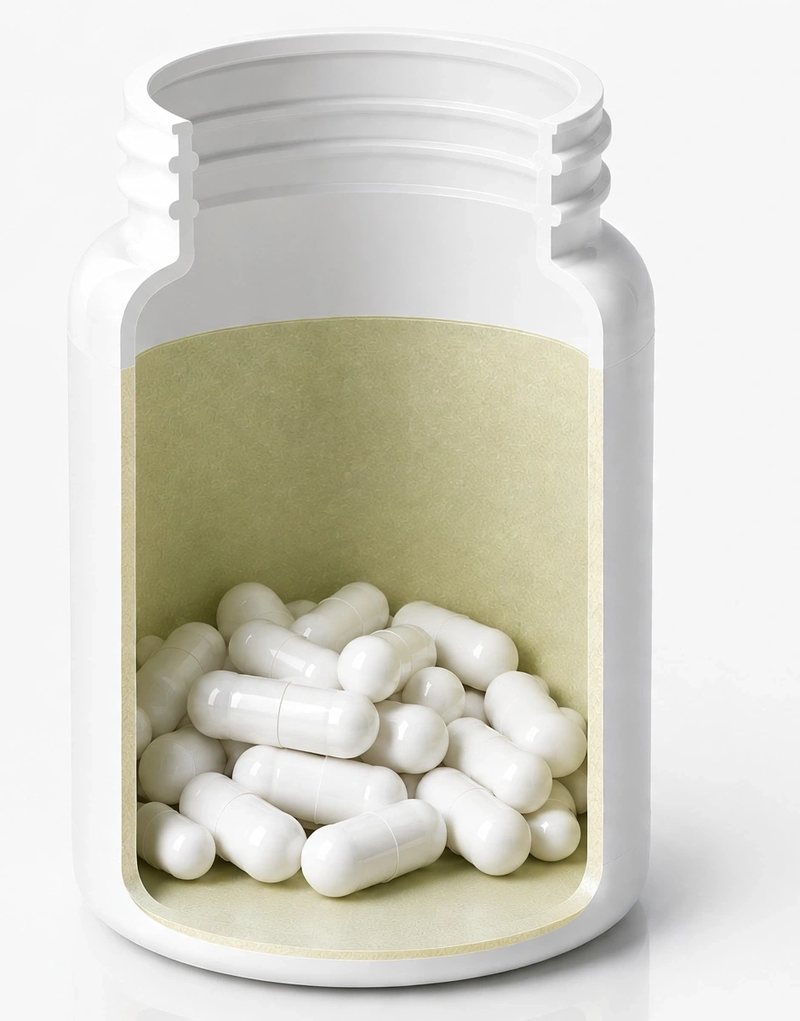
  • Bottle DryCoated onto the container wall. Keeps contents ultra-dry
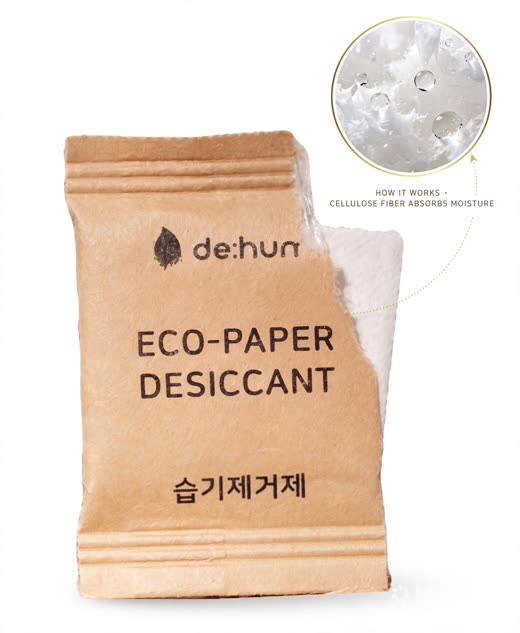
de:hum eco-paper desiccant — kraft exterior with cellulose fiber core
Performance benchmark

Higher performance. Lower carbon. Proven recyclability.

Five desiccant types compared on equal terms. Performance, carbon, recyclability — leading on all three.

100 75 50 25 Absorption Carbon reduction ESG & regulation Cost Recyclability Safety de:hum Max Dry Silica gel Calcium chloride Zeolite Clay ※ Absorption: KTR test basis. Carbon: absorption-equivalent, verified via Carbonbook. Cost: price per gram of water absorbed.
Score calculation basis
0–100 scale, range (min–max) shown. Higher is better. Score of 100 = 200% absorption of own weight.
① Absorption  |  Max Dry 134.7–155% · silica gel 30–35%
② Carbon reduction  |  1.44 vs 7.56 kg CO₂e/kg (absorption-equivalent)
③ Safety  |  No hazardous substances detected · no leakage or heat generation
④ ESG & regulation  |  Meets EU PPWR recyclability requirements
⑤ Cost  |  Cost per gram of water absorbed · on par with silica gel
⑥ Recyclability  |  Disposed of with paper · SGS 100/100
※ Absorption: Max Dry is measured per KTR testing; calcium chloride per deliquescence equilibrium (long-term). Test conditions differ, and the gap may narrow under identical conditions.
※ Carbon reduction: cradle-to-grave (raw materials, manufacturing, disposal), absorption-equivalent basis. de:hum values are verified data; competitor values are estimates from published literature.
※ Calcium chloride liquefies after absorbing moisture and requires a separate container or tray, which is reflected in its safety and recyclability scores.
Verified data

Every number has a test behind it.

Key results confirmed in accredited third-party lab reports.

Absorption

RH 90% · 48 hours
134.7–155%
Max Dry absorption
1 g and 3 g products
KTR2021
35 days
Long-term durability
Performance held at 1 g · 3 g · 50 g
In-house2026.06

Environmental

Carbon · recycling · biodegradation
80%↓
Carbon emissions
Equal-absorption basis · 1.44 vs 7.56 kg CO₂e/kg
CarbonbookVerified
100/100
Recyclability: Good recyclability
CEPI/4evergreen protocol
SGS2026.07

A lab test that recreates the paper recycling process scored four things. It got full marks on all four.

0%35/35
Lumps that don’t break down

Material that fails to turn back into paper fibre and is screened out. Lower is better.

Coarse reject
0.39%15/15
Small unbroken flakes

Share of small pieces left in the recycled pulp. Lower is better.

Flake
626 mm²/kg40/40
Sticky contaminants

Area of adhesive or coating residue that can spoil recycled paper. Lower is better.

Macrostickies
Very good10/10
Spots on recycled paper

Whether the recycled sheet shows specks or blotches.

Optical homogeneity
93.4%
Biodegradation
BS EN 13432 · 180 days
SGS2023.06

Safety

Hazardous substances · food use
0/253
REACH SVHC substances detected
None of 253 detected
SGS2025.03
Pass
Food-use safety
PCBs · arsenic · lead and more
Korea Food Science Institute2024.11
99%+
Ammonia deodorization
At 120 minutes
KATRI2024.11
Our vision

Beyond desiccants,
a company that engineers moisture.

de:hum goes beyond desiccant manufacturing — moving toward packaging solutions that actively manage moisture.

Stage 01

Eco-friendly desiccant

Entering the market with paper-based desiccants that replace plastic.

Stage 02

Moisture-control packaging

Integrating moisture control into the packaging itself — expanding to a structure that needs no separate sachet.

Stage 03

Sensor-integrated solutions

Evolving into intelligent packaging solutions combined with humidity data.

The company

de:hum

de:hum, founded in 2023, is an eco-friendly paper desiccant company. We replace the environmental burden of silica gel with paper, pursuing both absorption performance and sustainability.

Targeting global market expansion, we provide industry-specific custom moisture control solutions.

Patent Roadmap
Granted Pending Company
NOV 2022
KRFoundation
10-2464347
Method for manufacturing a pulp-type desiccant
Core of Max Dry
EST. 2023
de:hum
Founded
JUL 2023
KRFormat
10-2552149
Plate-type moisture absorber
Card & sheet formats
OCT 2024
JPGlobal
JP 7579017
Pulp-type desiccant — Japanese family of KR 10-2464347
First overseas grant
MAR 2026
KRNext-gen
10-2944390
Spherical desiccant
Bead-form paper desiccant
JUN 2026
KREco
10-2981293
PLA-laminated biodegradable desiccant packaging & its manufacturing method
Plastic-free outer pack
PENDING
KRSmart Dry
Filed
Bidirectional ambient humidity control article and composition
Core of Smart Dry
Get started

Find the right moisture solution for your industry.

Tell us your industry, volume, and target humidity — we'll send you a customized proposal.
Home › Industries › Apparel & Outdoor
Apparel & Outdoor

Protect what you ship. Protect the planet.

Protecting garments from moisture and mold during ocean shipping — while keeping your brand's sustainability promise.

The challenge

Moisture is a problem. So is the fix.

During long-haul ocean shipping, condensation inside containers leads to mold, stains, and odors — causing returns and brand damage.

But the solution used until now, silica gel, comes in plastic packaging. As global packaging rules tighten, plastic sachets score worse and worse on recyclability.

In transit

From inside the box to the container wall, we design the whole shipment.

At sea, a container heats up by day and cools at night. Droplets form on the ceiling and walls and fall onto the cargo, the “container rain” behind most mould and staining. de:hum catches moisture layer by layer, from the product out to the container itself.

  1. Inside polybags · cartons0.5–5 g sachetsThe first line of defence, closest to the product. Absorbs moisture left inside each pack.
  2. On top of the loadLarge sachetsPlaced on cartons and pallets to catch condensation falling from above.
  3. Container space50 g large sachetsPlaced near the walls and ceiling to lower humidity in the air, reducing the conditions that cause container rain.

Tell us the route, duration, season and load, and we size the dose per CBM.

* Video illustrates placement.

Why Max Dry

Six reasons why brands choose de:hum.

Performance · Environment · Safety · Regulation — leading on every key criterion.

Absorption
~4× higher absorption
Absorption 134.7–155% / 48h — about 4× silica gel (30–35%). Stable absorption even at high humidity.
Maximum absorption performance
CO₂ Reduction
~80% CO₂ reduction
~80% lower carbon footprint on an absorption-equivalent basis. Verified CO₂ data supports your Scope 3 reductions.
Carbon savings
Safety
Hazardous substances not detected · biodegradable
KTR: all hazardous substances not detected. Biodegradable cellulose-based material. No chemical leakage.
KTR tested
ESG Compliance
Designed for EU PPWR
Designed for EU PPWR recyclability requirements. Carbon data you can use in ESG reporting. Strengthens your brand's sustainability image.
PPWR-ready design
Recyclability
Dispose directly in paper stream
SGS recyclability test: 100/100 Good recyclability. Goes straight into the paper recycling stream with no separation needed.
SGS 100/100
Proven Trust
Proven global trust
Supplied to Discovery · Matin Kim · Benetton and 30+ brands. Patents registered in Korea and Japan; verified by SGS and KTR third-party testing.
Global reference
Product lineup

Choose the size for your shipping conditions.

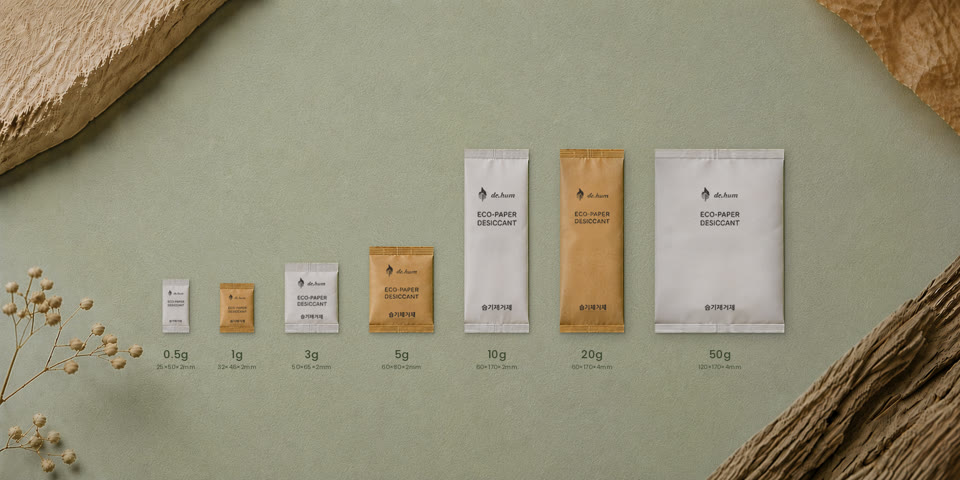
High-absorption one-way desiccant sachet optimized for apparel and outdoor shipping. Choose the size to match your box volume and shipping conditions.

Max Dry lineup — every size from 0.5 g to 50 g
SpecificationFormSize (mm)Key applicationsRecommended dose
0.5 gSachet25 × 50 × 2Small apparel packaging1 ea per poly bag
1 gSachet32 × 46 × 2Small apparel packaging1 ea per poly bag
3 gSachet50 × 65 × 2Medium-large apparel packaging1–2 ea per box
5 gSachet60 × 80 × 2Per apparel box1 ea per box
50 gLarge sachet120 × 170 × 4Large boxes · containersCalculated per CBM
Cellulose-based paper core Kraft outer layer Logo and design printing Customization from MOQ
Custom branding

Even the desiccant becomes part of your brand.

Your logo and brand colours, printed on the sachet. The small pack customers meet first when they open the box can match the rest of your packaging.

Logo · copyPrint your logo and any line you like
Outer colourMatch the outer to your brand colour
SizeChoose from 0.5 g to 50 g
Eco messageAdd disposal or sustainability messaging
How it worksSend logo · coloursApprove print proofSample runMass production
Lead time3–4 weeks from orderMOQOn request

* Brands shown in the video are examples.

Proven trust

What brands saw for themselves.

OUTDOOR · SPORT · FASHION · LIFESTYLE — interview summaries from 8 brand buyers

Hyundai · Handsome
Premium printing · eco value · brand sensibility
"The print quality matches our premium line perfectly. A refined way to communicate sustainability with the feel of our brand."
Head of Apparel
Benetton
Custom branding · brand promotion · optimal solution
"A perfect fit for custom branding, with excellent core performance. The ideal way to run multiple brand promotions at once."
Production & procurement team
Matin Kim
Custom logo · brand identity · environmental value
"With a custom logo, we unified our brand identity across all packaging and effectively conveyed our sustainability values to customers."
Brand packaging team
Malbon Golf
Carbon footprint reduction · sustainable marketing
"We use the carbon reduction data in our marketing. Being able to show sustainability through packaging alone is a major strength."
Production & procurement team
Nordisk
ESG marketing tool · eco message · global strategy
"It's a global ESG marketing tool. The moment the product is opened, the sustainability message comes through naturally."
Sustainability team
Discovery Expedition
Performance · optimal solution · immediate response
"The optimal solution, delivering both performance and competitiveness. Our team and in-store customers responded immediately."
Head of Procurement
Snow Peak
Perfect absorption · outdoor mood · sensibility & ethics
"The natural material absorbs moisture perfectly and fits our outdoor mood. A perfect balance of aesthetics and ethics."
Design team
Thisisneverthat
Brand identity · eco packaging · core competitiveness
"Packaging that strengthens brand identity and carries sustainability values is a core competitive edge in street fashion."
Marketing team

* Summarized from interviews with partner representatives; wording may differ from what was said.

Why you can't wait

Switch now, or regulation will switch you.

EU · Japan · Korea — plastic packaging regulations are tightening simultaneously in key markets. Silica gel in plastic sachets is at a disadvantage under these rules.

EU PPWR · 2026.08

3 Key EU PPWR Requirements

Applies to all 27 EU countries · includes desiccants
2030
Recyclability gradesOnly Grade C (70%) or better may be sold in the EU
40%
Reuse and minimizationEmpty space ratio limited to under 40%
PFAS
Hazardous substance restrictionsPFAS limits for food-contact packaging · heavy-metal limits
Paper desiccant: designed for the recyclability and substance requirements
KOREA

Extended Producer Responsibility

EPR fees · supply-chain ESG
2023
Packaging material & structure improvementStricter regulations on hard-to-recycle packaging
NOW
EPR levy enforcementLower recyclability grade = higher cost
NEXT
ESG disclosure rules under discussionGrowing supply-chain requests for packaging data
Legal obligation + supply-chain ESG requests

SOURCE · EU REGULATION 2025/40 · Ministry of Environment Packaging Material Improvement Notice · Plastic Resource Circulation Act

The solution landscape

There is an alternative. Compare the data yourself.

Regulation · Eco · Safety · Cost — a clear-eyed comparison on 4 key criteria.

Evaluation criteria Paper desiccant Silica gel Zeolite Calcium chloride
EU PPWR ✓ Designed for ✕ At a disadvantage △ Partial ✕ At a disadvantage
Eco-friendliness Biodegradable · carbon verified Plastic · disposal Natural mineral · mining burden Chemical substances · contamination
Safety No hazardous substances detected Inhalation caution Dust caution Skin · clothing damage
Absorption performance 134.7–155% / 48h 30–35% / 48h Medium-high · regenerable High · risk of liquefaction
ESG Disclosure Carbon data provided Not possible Partially possible Not possible
Cost structure Lower TCO Higher TCO High cost Safety cost ↑
Get started

Before regulations kick in,
prepared brands lead.

Start the transition with free samples and a customized proposal.
Explore other industries

Food
Food · In development
Pharma & Health
Pharma · Health supplements
Electronics & Battery
Electronics · Battery
Home › Industries › Pharma & Health
Pharma & Health

Target humidity design. Integrated package.

Precisely controlling the humidity that determines the shelf life of pharmaceuticals and health supplements — with paper.

The challenge

Too high or too low — both fail.

Every drug has its own acceptable relative humidity (RH) range. Probiotics die if they get too dry; tablets dissolve if they get too humid. Quality is guaranteed only within the target humidity range.

Silica gel is a one-way desiccant that only absorbs. It keeps pulling in moisture and causes over-drying, and it cannot release moisture back to hold a target level. The precise humidity control pharma requires is impossible.

Probiotic capsules
10–20%
RH
Probiotics
Powder · capsule
Optimal 15% RH
Tablets
≤20%
RH
Tablet
Effervescent · hygroscopic API · ODT
Optimal 10% RH
HPMC vegetable capsules
10–40%
RH
HPMC Capsule
Vegetable capsule
Optimal 25% RH

※ Target RH varies by formulation. Quality changes occur when the range is exceeded.

Regulatory landscape

Three regulations apply to pharma packaging simultaneously.

Silica gel canisters face growing scrutiny on GMP safety, pharmacopoeia standards, and environmental rules.

GMP · Safety

Enhanced raw material safety

cGMP · ICH Q3D standards
NOW
Silica gel dust inhalation riskFine particle leakage · cross-contamination risk
ICH
Elemental impurity control strengthenedImpurity review required for desiccant-derived substances
2030
Pressure to transition to natural materialsTrend toward reducing synthetic chemical use
Paper desiccant: zero dust · natural material
EU PPWR · Environment

Packaging recyclability requirements

Applies Aug 2026 · design rules from 2030
2030
Design-for-recycling rulesSupplements and secondary packs in scope · medicinal immediate packaging exempt (review 2035)
PFAS
Hazardous substance restrictionsPFAS limits for food-contact packaging
ESG
Pharma company ESG disclosure expansionCarbon data required for packaging materials
Paper desiccant: designed for recyclability requirements
Product line

Three product lines designed for pharma applications.

Choose the optimal moisture control method based on your application and packaging structure.

Smart Dry two-way small sachet
Max DrySmart Dry

Small sachets

Small paper desiccant sachets for drug bottles, blisters, and pouches. Max Dry offers one-way high absorption; Smart Dry offers two-way ERH control to match each formulation.
0.2g / 0.5g small sachet
Max Dry: one-way · high absorption (134.7–155%)
Smart Dry: bidirectional · target humidity maintenance
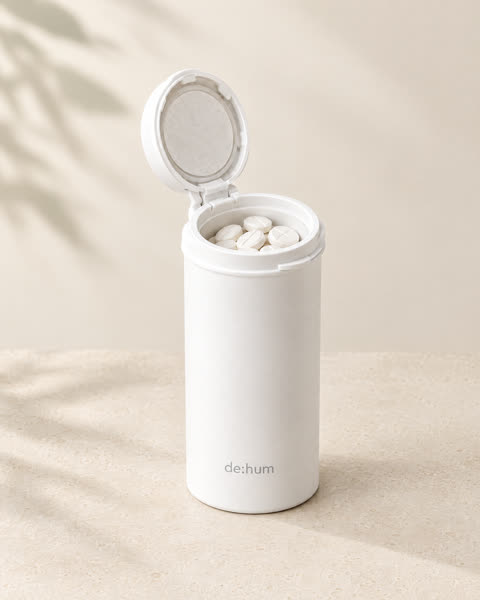
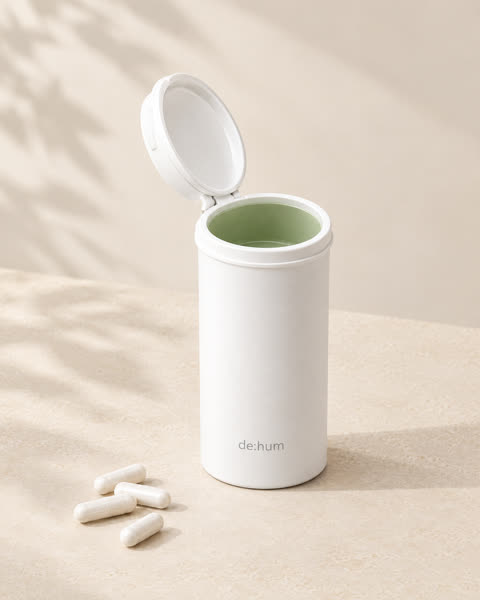
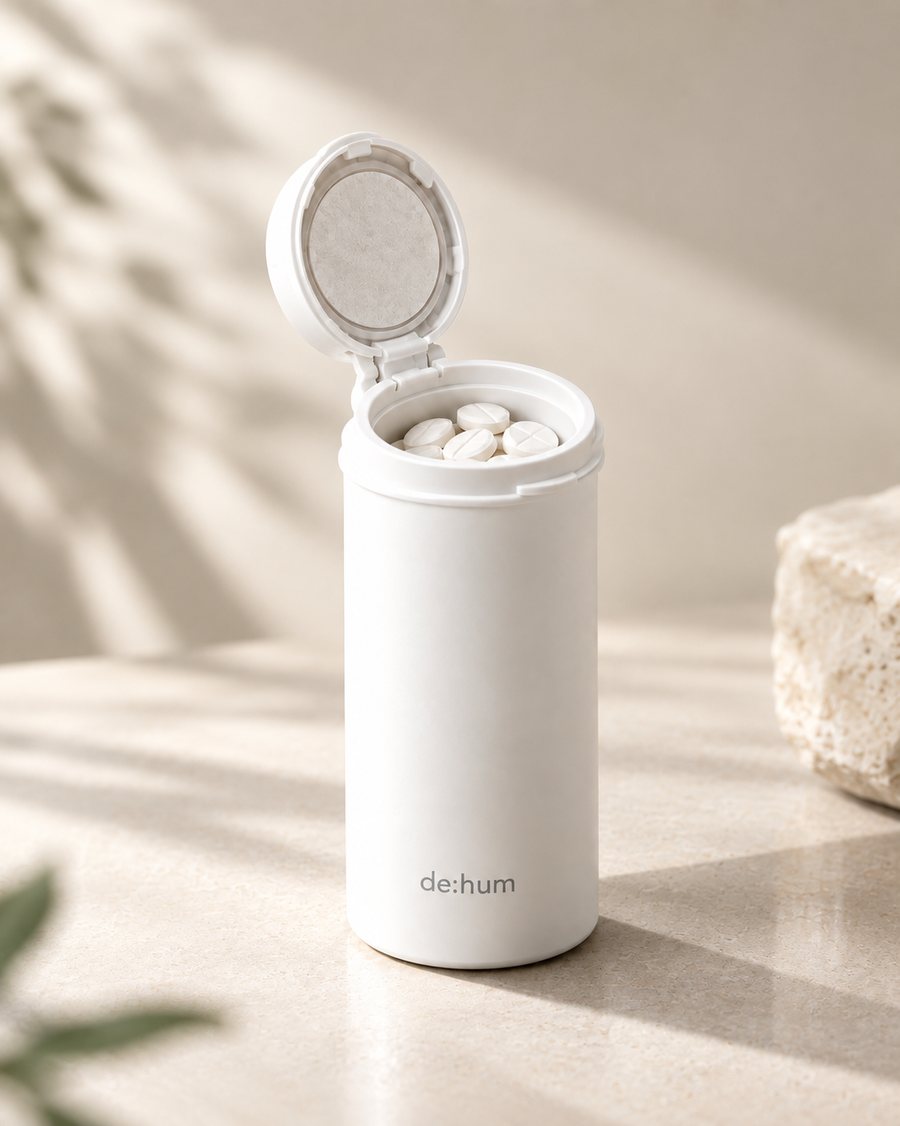
Cap Dry container with built-in desiccant disc
Cap Dry

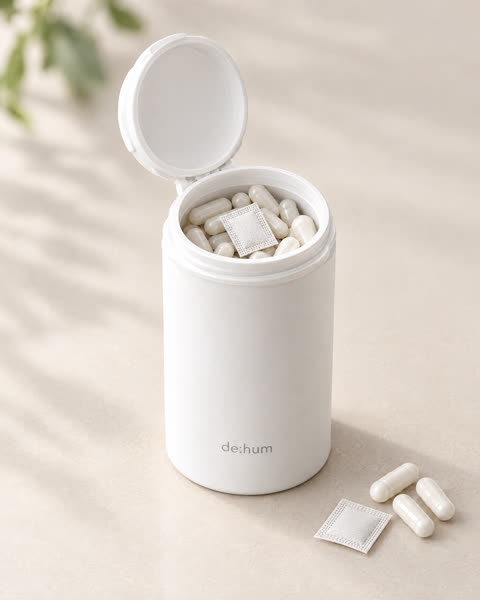
Container with built-in desiccant disc

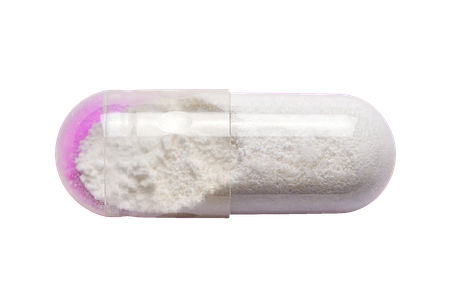
A structure that holds a low-humidity state at the target aw. A de:hum desiccant disc built into the cap keeps the set humidity stable without over-drying.
Target aw maintained · prevents over-drying
Lid-integrated · replaces silica gel canister
Application: probiotics · health supplements · capsules
See details →
Bottle Dry coated desiccant container
Bottle Dry

Coated desiccant container

Moisture-absorbing material is coated directly onto the container's inner wall, rapidly bringing RH below 5% for an ultra-dry environment. The container itself removes the moisture, with no separate desiccant.
RH below 5% within 3 min · extreme dryness maintained
Coating (container wall) · film (cases, trays)
Application: tablets · effervescent · diagnostic kits · moisture-sensitive materials
See details →
Head to head

Silica gel canister vs. paper desiccant — head to head.

Comparing key criteria from a pharmaceutical packaging perspective.

Evaluation criteria Paper desiccant Silica gel canister
Humidity control Bidirectional ERH control possible One-way absorption only · over-drying risk
Safety Zero dust · natural material Fine particle leakage · cross-contamination
Packaging structure Integrated (Cap/Bottle) possible Separate canister insertion required
EU PPWR ✓ Designed for ✕ Plastic at a disadvantage
ESG Disclosure Carbon reduction data provided No data
Process efficiency Cap/Bottle = eliminates insertion process Canister insertion process required
Why de:hum for Pharma

There's a reason pharma is choosing paper desiccants.

Safety · Precision Control · Regulatory Compliance · Eco-friendly — designed around what pharma requires.

Precision
Bidirectional humidity control
Absorbs and releases moisture. A paper-based solution that lets you design a target aw and hold it.
Smart Dry ERH
Safety
Zero dust · natural material
Cellulose-based. No risk of fine-particle leakage or cross-contamination. KTR: all hazardous substances not detected.
KTR tested
Integration
Integrated package
Cap Dry · Bottle Dry eliminate the canister insertion step, simplifying the packaging line and cutting costs.
Process optimization
Compliance
Built for GMP · PPWR
Addresses cGMP safety review and EU PPWR recyclability with a single material. Packaging carbon data provided.
PPWR-ready design
Is it a fit?

One question first: does the product have a humidity floor?

With a floor, Cap Dry holds the target humidity. Without one, drier is better and Bottle Dry is the answer.

Cap Dry
Has a humidity floor
  • Hard gelatin capsules (brittle below RH 40%)
  • Freeze-dried probiotics (potency loss when over-dried)
  • Dry powder inhalers (static at low RH)
  • Jelly · gummy forms (hardening, sticking)

Cap Dry is validated for targets of RH 20% and above; below RH 20% is in validation.

Bottle Dry
No humidity floor
  • Effervescent · orally disintegrating tablets
  • Diagnostic test strips
  • Moisture-labile APIs (aspirin, cephalosporins)
  • Hygroscopic ingredients · bulk packs
Keeping your current bottle or pouch?Drop in a 0.2 g or 0.5 g Max Dry (one-way, high absorption) or Smart Dry (two-way, target humidity) sachet instead.
Cap Dry

The cap becomes the desiccant. Target humidity, held.

An integrated cap with a paper desiccant disc inside the lid. No canister or sachet goes into the bottle: moisture that comes in each time the cap is opened is caught in the cap itself.

Designable target humidity
RH 20% and aboveTarget humidity design · validated
Below RH 20%In validation
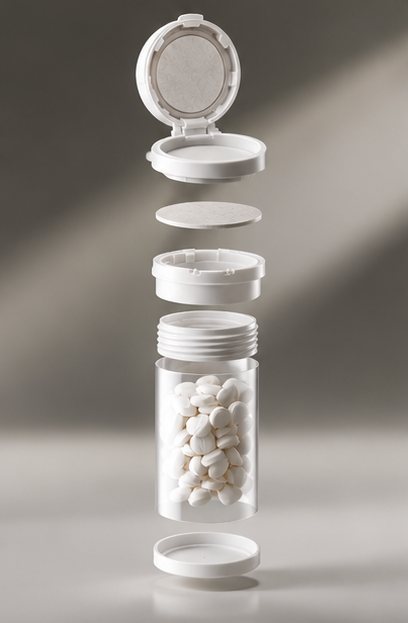
Cap Dry container with the disc built into the lid
Cap Dry exploded view

Construction

  1. CapCloses tightly to keep outside moisture out
  2. Paper desiccant discAbsorbs moisture inside the lid
  3. Cap housingHolds the disc in place, away from the contents
  4. Bottle neckBlocks moisture at the closure
  5. ContentsKept dry and stable
Paper desiccant disc inside the lid
~4×
Absorption
vs silica gel · by own weight
93.4%
Biodegradation
BS EN 13432 · 180 days
0/253
REACH SVHC detected
None of 253 detected
0
Desiccant parts in the bottle
No canister or sachet
A good fit for
Hard gelatin · HPMC capsulesSupplement tablets · capsulesForms sensitive to over-drying

Forms that target below RH 20%, such as probiotics, are currently in validation.

* Product images are concept renderings.

Bottle Dry

When sachets and canisters
can’t reach ultra-dry

For some products, headspace humidity won't come down with a sachet or a canister.
With Bottle Dry, the container's inner wall itself becomes the desiccant.

<5%
RH 75% → below 5% within 3 minutes
Moisture entering upon opening fully recovered before next opening
72h
Lower humidity limit maintained for 72+ hours
12 L chamber · 24.5°C · starting at RH 35%
4h
Room-temperature cure, existing containers unchanged
Liquid coating → 4-hour cure. No mold or resin changes.
Best fit ——
Effervescent tablets Diagnostic strips Hygroscopic APIs Bulk ingredients
What changes

When the container becomes the desiccant, five things change.

01
Space
Canister space goes
back to the product
02
Process
Three steps come off
the filling line
03
Patient
Nothing to remove,
nothing to swallow
04
Design
Sized by surface area,
not by unit
05
Waste
One fewer
packaging component

It's not the benefit of a better desiccant. It's the benefit of eliminating a component.

Verified
Proven performance
Relative humidity → 0% RH in 40 seconds (23.3°C chamber test)
Lower humidity limit held for 72 hours (12 L chamber, 24.5°C)
No hazardous substances detected in any category (KTR third-party test, MFDS criteria)
Confirmed compliant with Korean household chemical product safety standards
How Bottle Dry works

Moisture is caught at the wall, not in the middle.

A liquid desiccant layer is coated onto the container’s inner wall and base. It cures at room temperature in about 4 hours and is not visible in the finished container.

Cutaway of a bottle with the desiccant layer on its wall and base
  • Top · uncoatedNeck and threads stay uncoated, so sealing and closure torque are unchanged.
  • Inner wall · coatedThe working surface. Coated area is specified per container.
  • Base · coatedThe largest continuous surface and closest to the contents.
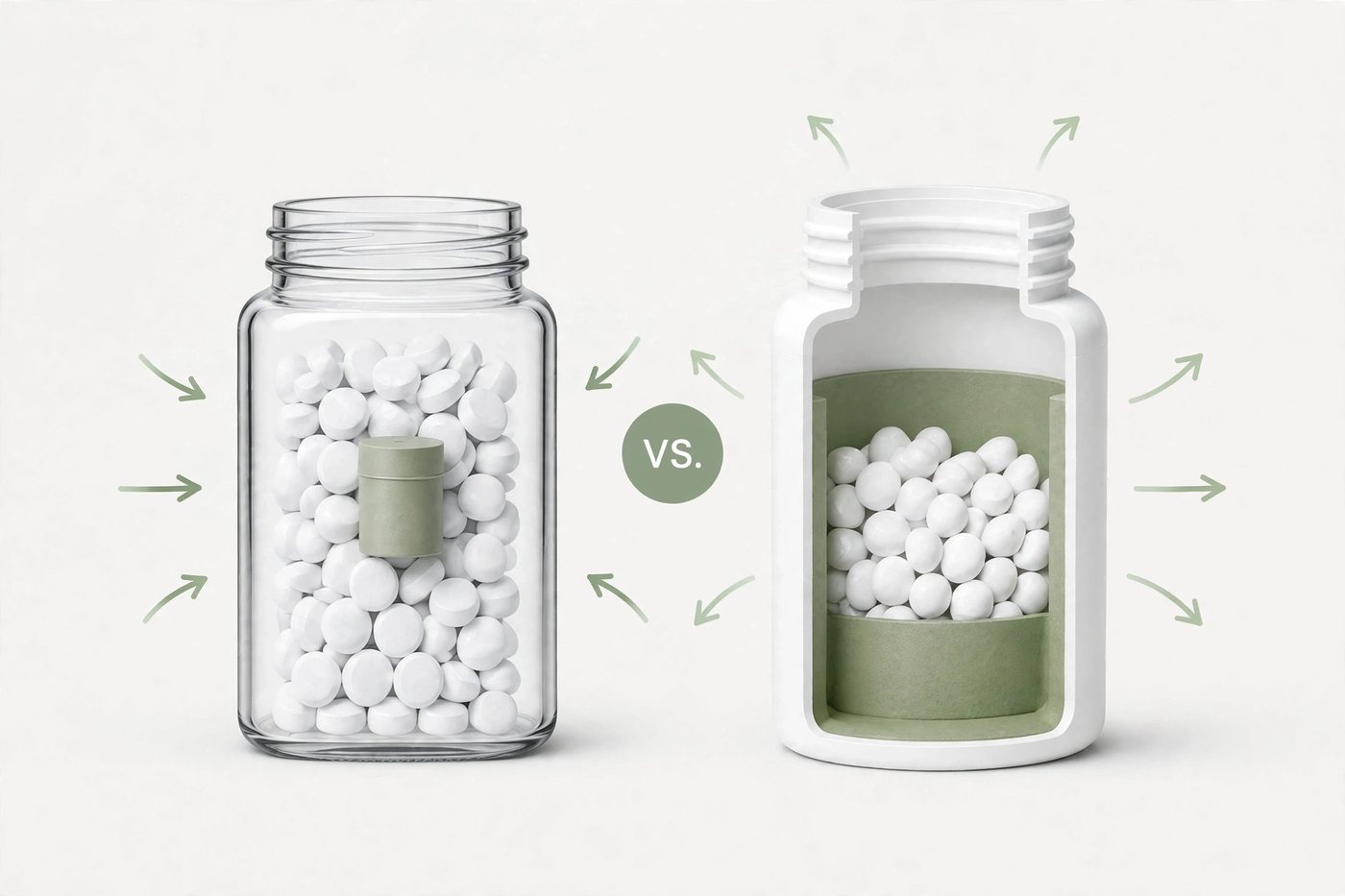
Canister versus Bottle Dry
Canister

Moisture has to cross the whole container to reach the canister.

Bottle Dry

Moisture is stopped at the wall before it reaches the contents.

Existing moulds and resinNo new container needed
Clarity and strengthContainer properties are kept
Capacity designSet by coated area, not formulation
Lead timeA post-process step, not a new container

Three steps leave the filling line.

Canister process
MouldingCanister insertionRemovedVision checkRemovedReject handlingRemovedFillingCapping
With Bottle Dry
Coated containerFillingCapping

Coating happens at container manufacture, so the filling line needs no inserter, vision station or reject line. Room-temperature curing adds no ovens or dryers.

Bottle Dry: current scope

ValidatedIn validationNot supported
ContactHeadspace onlyDirect contact with solidsLiquids · injectables
SubstrateRigid PP · PEPET · glass · board · metalElastomers · textiles
GeometryStraight walls · baseCurves · undercuts · narrow necksVery small openings
FormCoating · filmPre-coated liners · discsPowder · granules
SectorElectronics · industrialPharma · probiotics · diagnosticsSterile medical devices

Assumes products without a humidity floor. Anything not listed is treated as unvalidated until tested with the customer.

How we verify

Every number, measured like this.

Absorption, target humidity, headspace RH — every figure in our proposals is measured on the equipment below, and safety is verified by independent labs.

Temperature and humidity chamber
Absorption

Temperature & humidity chamber

Measures moisture uptake over time under set temperature and humidity.

→ Absorption rate · speed
Water activity analyzer
Target aw

Water activity analyzer

Measures the water activity (aw) each formulation needs, to design the target humidity.

→ Smart Dry · Cap Dry target aw
WVTR analyzer
Barrier

WVTR analyzer

Measures how much moisture enters through the container and packaging.

→ Required desiccant capacity
Digital humidity logger
Headspace

Digital humidity logger

Records headspace humidity inside the container in real time.

→ ultra-low RH reached · 72 h hold
Third-partyKTR: no hazardous substancesSGS recyclability 100/100Household chemical safety standard
Validation in progress

Technical validation underway with major domestic companies.

Technical validation is underway with major domestic pharmaceutical and health supplement companies.

01
Probiotics company
Capsule-type health supplements
Cap Dry validation in progress
02
Tablet pharmaceutical company
Moisture-sensitive tablets
Bottle Dry application under review
03
Health supplement brand
Small Smart Dry sachet
Two-way ERH performance testing in progress

* Ongoing technical validation project. Client names are confidential.

Get started

Custom moisture management design for your pharmaceutical product.

Tell us your target humidity, container specs, and distribution conditions — we'll propose the optimal solution.

Explore other industries

Apparel & Outdoor
Apparel · Outdoor
Food
Food · In development
Electronics & Battery
Electronics · Battery
Electronics & Battery

Condensation in sealed spaces,
controlled for 10 years, fit and forget.

Battery packs, cameras, lights, electronics — controlling condensation in sealed spaces with repeated temperature cycles using a bidirectional humidity-control material. No power, no replacement.

The challenge

Every temperature cycle
crosses the dew point.

Even IP67-sealed housings breathe in humid air through breather vents. The moment the temperature difference between the cooling channels and cell surfaces drops below the dew point, trapped moisture turns into condensate.

The result: insulation breakdown, busbar corrosion, connector shorts, and accelerated thermal runaway — issues directly tied to safety.

Too dry is a problem too. Insulating plastics and seals harden and micro-crack, letting moisture back in. That is why you need a material that holds humidity within a range, not one that only absorbs.

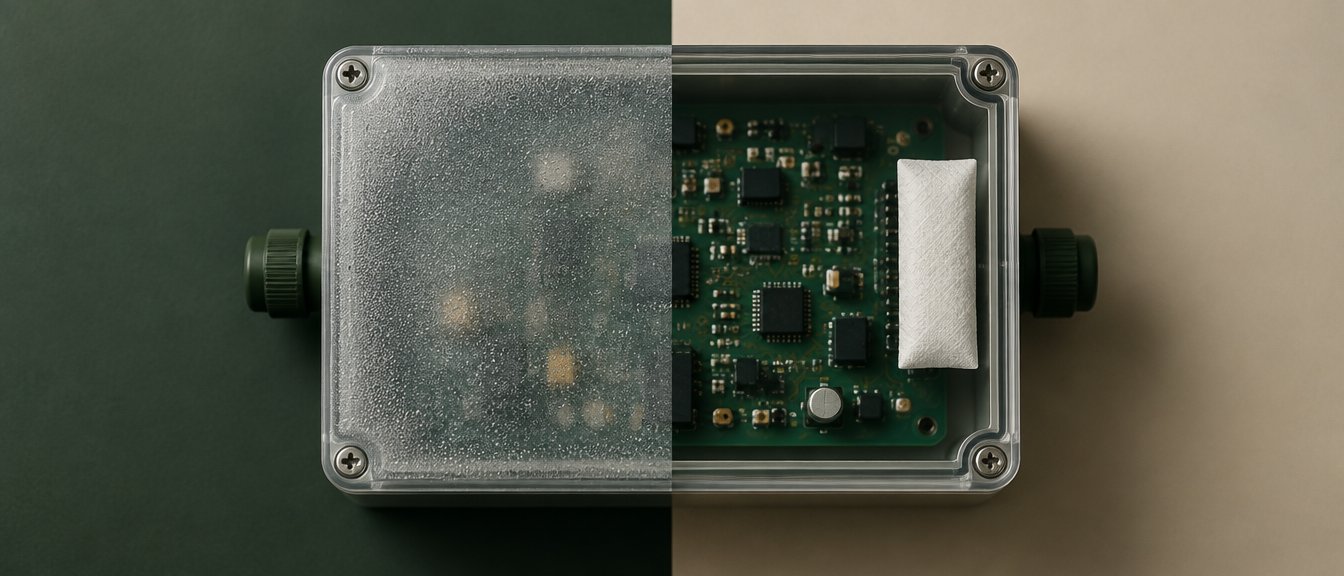
Left: enclosure lid fogged by condensation. Right: clear enclosure with Smart Dry attachedCondensation insideWith Smart Dry
Same enclosure, different outcome. One humidity-control pack keeps condensation from clouding the board.* Concept image.
Why existing solutions fail

Conventional desiccants will always saturate.

Not a material that absorbs more — one that self-regenerates without saturation.

Evaluation criteriaSmart DrySilica gelMolecular sieveClayCalcium chloride
Control methodBidirectional ERH cyclingOne-way · stops at saturationOne-way · early saturationOne-way · releases at high tempOne-way · liquefaction
High-temperature stabilityWorks after 100°C aging35°C↑ performance degradesRe-releases moisture at high temperatureReleases moisture at high temperatureLiquefaction after deliquescence
SafetyZero dust · zero leakageFine particulate riskDust generationDust generationChloride ion corrosion
High-voltage section placement✓ Possible△ Limited△ Limited✕ Not possible✕ Not possible
Volume efficiencyUp to 1/4 volume (up to 4× absorption)Baseline (1×)SimilarSimilarLarge container required
Life cycleNo replacement needed · self-regeneratingReplace after saturationReplace after saturationReplace after saturationDiscard after saturation
The solution

Smart Dry cycles without saturation.

Above the target ERH: absorbs. Below: releases. Maintains the set range.

Bidirectional
Cycling without saturation
Absorbs and releases around the set ERH. Keeps RH swings within 20%RH.
Maintained below condensation risk threshold
Compact
Same performance at up to 1/4 volume
Absorption 100–155%. The same effect at as little as one quarter of the volume. Fits even in the gaps between cells.
Can be placed in module gaps
Safe
Zero dust · zero leakage
Stays solid after absorbing moisture. No liquid leakage or dust, so it can sit close to high-voltage parts.
OK near busbars · connectors
Install
Stick it and forget it
Attaches anywhere with 3M adhesive backing. A passive material that needs no power, wiring or replacement.
Power-free · maintenance-free
Measured case

Humidity peaks held below the condensation line.

A sealed electromechanical device run through 25 hours of temperature and humidity cycling. Without a humidity-control pack, internal RH crosses the condensation risk line (RH 80%) every cycle. With Smart Dry it stays within RH 60–72%.

15ptMax reduction in RH peaks
0Crossings of the risk line (with pack)
607080900510152025RH %Condensation risk · RH 80%+Without Smart DryWith Smart Dry
Peak reductionx-axis: hours

* Chart reconstructed from the manufacturing partner’s measured data. Results depend on housing design and operating conditions.

Application scope

Beyond batteries, it applies to three core systems.

Temperature cycles inside EVs — from headlights to cameras to battery packs — cause condensation in every sealed component. Smart Dry is customized for each system.

Issue 01
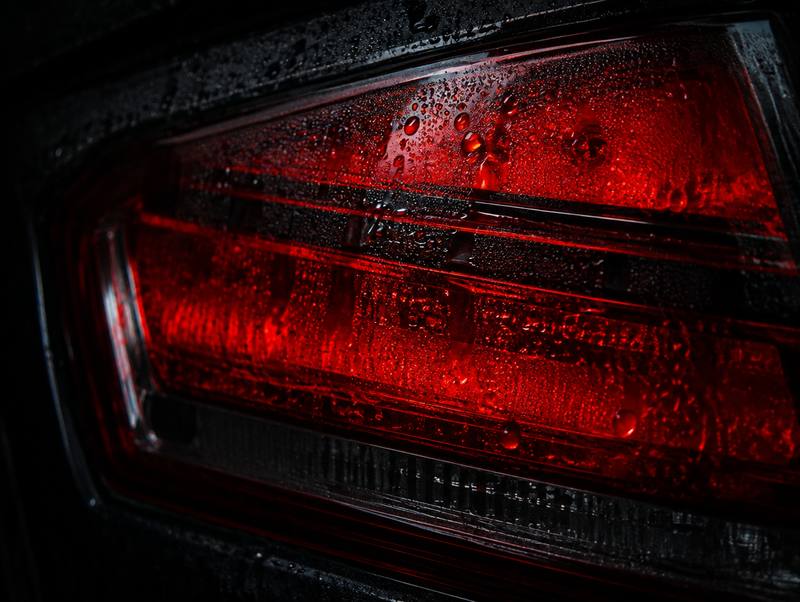
Condensation inside a vehicle headlamp

Lighting systems

When moisture gets inside headlights and taillights, it leads to reduced brightness, poor visibility, and warranty claims. Breather vents alone can't stop the condensation that returns with every temperature cycle.

Current approach
Breather vent
Reduced visibility Warranty claims
Issue 02
Fogged vehicle camera lens

Camera systems

Fogging inside B-pillar, front, and rear-side cameras temporarily disables autonomous driving and safety features. The more an ADAS relies on cameras, the more critical this becomes.

Current approach
Pre-run HVAC system · breather vent
Autonomous driving disabled
Issue 03
EV high-voltage battery pack

High-voltage battery

Moisture ingress into battery packs causes voltage sensor errors and busbar corrosion. In severe cases it leaves the vehicle unable to drive or charge and the pack needing replacement.

Current approach
Desiccant insertion · breather vent · ePTFE membrane
Unable to drive or charge
Smart Dry · EV applications

7 components.
One material.

Smart Dry is customizable in size and target humidity — applying the same material from lighting to battery packs, tailored to each component.

Where it goes
1Charging portCharge inlet
2Battery management systemBMS enclosure
3Battery packPack interior
4Intelligent driving moduleADAS sensors
5Drive motorMotor housing
6Intelligent driving controllerDomain controller
7Tail lightRear lamp
Smart Dry
Anti-condensation Pack
61 × 30 × 4.5 mm
100–155%
Absorption
RH 95% · 24 h
45%+
Release
45°C · RH 80→60%
40%+
Bidirectional
RH 50–70%

Durability

  • Absorption after cycling−40 ↔ 85°C≥40%
  • Absorption after heat aging100°C · up to 1,000 h≥35%
  • Waterproof after damp heat85°C · 85%RHIPX8
  • Service life10+ years

Material · install

  • ConstructionBreathable film + control core
  • Mounting3M adhesive backing
  • FlammabilityCoreUL94 HB
  • Metal contactNon-corrosive · halogen-free
  • SizeCustomizable

* Service life, durability and flammability follow the manufacturing partner’s specification and internal testing. Detailed spec sheet available on request.

Beyond EV

The same fix works in any sealed enclosure.

Wherever a sealed space heats and cools, the same principle cuts condensation.

ESS battery cabinetsCondensation and corrosion in large battery racks
Telecom base stations4G/5G outdoor units and fibre enclosures
Power control panelsTerminal blocks and breakers
EV chargersElectronics inside outdoor chargers
Solar invertersOutdoor units with wide day–night swings
Outdoor CCTV · sensorsLens fogging and board corrosion
LED lightingCondensation inside luminaires
Equipment cabinetsCabinet interiors HVAC doesn’t reach
How we verify

We recreate real driving conditions in the lab.

Temperature cycling and condensation, long-term aging, pack-level conditions. We reproduce what vehicle components go through inside the chamber to verify Smart Dry.

Temperature and humidity chamber
Condensation

Temperature & humidity chamber

Repeats temperature cycles to reproduce condensation inside housings.

→ Two-way ERH control · RH swing
Environmental simulation chamber
Durability

Environmental simulation chamber

Long-term exposure to heat and humidity to check for performance loss.

→ Service life · saturation
Climate room
Pack-level

Climate room

Tests at actual pack and module scale under driving conditions.

→ Measured data by location
WVTR analyzer
Venting

WVTR analyzer

Measures moisture ingress through vents and seals.

→ Desiccant size · count design
MaterialHalogen-free · non-corrosiveIn production with manufacturing partner
Proven in the field

Already proven in the EV supply chain.

The same reversible humidity-control material is being applied to sealed components from battery packs to autonomous driving cameras.

Company H Global ICT
Autonomous driving controller (passenger vehicle)
In application
Company H Global ICT
Automotive radar (near headlamps)
In application
Company S Global electronics
CCTV Camera
In delivery
Battery maker Global
Traction battery pack (passenger & commercial)
Under evaluation

* As of September 2026. Application status is based on manufacturing partners. Detailed specifications shared under NDA.

Get started

Application validation — de:hum leads the way.

Current desiccant method in your pack, required temperature range, application location and available space — share with us and we'll customize.

Explore other industries

Apparel & Outdoor
Apparel · Outdoor
Food
Food · In development
Pharma & Health
Pharma · Health supplements
In development
Food & Beverage

Food solutions, in the works.

We are developing paper desiccants for moisture-sensitive food packaging such as coffee, snacks, and dried foods.

This page is under development. Product specs and use cases will be published once development is complete. Contact us to get launch updates first or to join sample testing.

Explore other industries

Apparel & Outdoor
Apparel · Outdoor
Pharma & Health
Pharma · Health supplements
Electronics & Battery
Electronics · Battery
Impact

The environmental value
one desiccant changes.

See your annual CO₂ savings, regulatory readiness, and quality gains instantly.
Estimated metrics to support your ESG reporting.

Progress 1/4
0%
1
Product
2
Info
3
ESG Impact
4
Business Value
STEP 1

Your perfect product

4 questions to find your fit

What is your product packaging size?
Select the closest match
Packaging sealing level?
Determines moisture infiltration risk
Main shipping/storage environment?
Weight varies by duration, temperature, humidity
Required humidity control mode?
One-way vs two-way depends on product nature
STEP 2

Basic Information

Enter your desiccant and scale — we calculate the impact of switching to de:hum.

🏭 Current Desiccant
📦 Scale & Export Info
×10,000 units
Adjusts by 100,000 units · direct input allowed
%
Export Country Standards
STEP 3

Your ESG Impact

For your product · ESG-report ready

Annual Transition Impact
t CO₂e
📐 Carbon Reduction Formula (Full Transparency)
Silica Gel Carbon = (Current weight × volume) × 1.89 kg CO₂e/kg
de:hum Carbon = (silica gel weight ÷ 4 × volume) × 1.44 kg CO₂e/kg
※ Equal-absorption basis: Max Dry (134.7–155%) absorbs about 4× more than silica gel (30–35%), so 4 g of silica gel = 1 g of de:hum. 1.89 × 4 = 7.56 kg CO₂e vs 1.44 kg CO₂e → about 80% lower (verified by Carbonbook).
Environmental Impact — Intuitive Equivalents
Trees Planted
0
KFRI 21.77kg CO₂/tree·yr
Car Driving
0km
MOE 0.165kg CO₂/km
Football Field Forest
0
FIFA 7,140㎡ · 30㎡/tree
ICN-LHR Flights
0
ICAO 1,100kg CO₂/pax
Annual CO₂ savings as trees
Resource Circularity
Plastic Pouches Removed
0 kg
PP/PE pouch → 100% biodegradable paper
Pouch Count
0 pcs
SGS recyclability 100/100
Biodegradable Conversion
0 t
PP/PE pouch → paper pouch total switched
Quality Stability Improvement
ESTIMATE
With Silica Gel
0%
After de:hum Switch
0%
Defects Prevented
0 units/yr
Defect Rate Improvement
0%
50% reverse-release contribution removed
Reship/Return Reduction
0%
Logistics burden reduced proportionally
⚠️ These defect rates are estimates from industry standards and research papers (ICH Q1A, Textile Research Journal 2018, IPC-1601, Food Packaging & Shelf Life 2020, WHO PQ, etc.). The 50% reverse-release contribution is per Packaging Technology & Science 2019. Actual rates vary by facility, packaging, routes, and storage.
Regulatory Risk Resolution
Displayed as compliance completeness, not monetary values.
Risk estimates provided separately during consultation.
ESG-Ready Metrics Summary
    STEP 4

    Business Value · Quote

    Tailored analysis at quotation.

    🔒Shared at consultation
    5 additional values we calculate
    Based on your scale and industry data — shared in consultation.
    💰
    Annual Defect Loss Saved
    ₩ █,███,███K
    Defects prevented × unit price
    📦
    Logistics & Re-ship Savings
    ₩ ███,███K
    Return & re-shipment cost saved
    📈
    Brand Value Uplift
    + ██.█%
    ESG transition premium
    ⚖️
    Regulatory Risk Avoided
    ₩ ███,███K
    PPWR · SVHC compliance cost
    🌱
    Carbon Credit Value
    ₩ ██,███K
    CO₂ saved × current credit price
    Total Annual Benefit (TCO)
    ₩ ██,███K
    Sum of all 5 values
    5 values + tailored report at quote
    FINAL STEP
    Turn this impact into
    real results
    Quote · samples · business analysis. Reply within 2 business days.
    Quote & samples
    2 business days
    Tailored analysis
    Public-tier environmental impact simulation tool.
    Estimates based on Carbonbook-verified factors · KTR tests · KFRI · ICAO · FIFA public data.
    de:hum ESG insights
    ESG Insights

    Sustainability,
    read together.

    de:hum's perspective on packaging regulations, material innovation, and ESG disclosure trends. Updated first on LinkedIn.

    Follow on LinkedIn
    LinkedIn Channel
    Subscribe to ESG insights from de:hum on LinkedIn.

    Updates on ESG disclosure regulations, investment trends, and de:hum activities.

    Visit →
    ESG trends
    Sustainable Packaging · Circular Economy
    PPWR is in force.
    Europe's answer is fiber.

    PPWR has taken effect across all 27 EU member states. Paper recycling rate 83% vs plastic 41% — the numbers show the direction. Note: "paper-look" packaging with a plastic liner is not recyclable. Desiccants are included.
    #PPWR #SustainablePackaging #CircularEconomy

    Sustainable Packaging · Recyclability
    Desiccants now need
    a recyclability grade too

    de:hum Max Dry is SGS-tested 100/100 "Good recyclability" — passing all 4 criteria with zero waste residue. A single silica gel sachet can drag down the grade of the entire pack.
    #Recyclability #PPWR #PaperDesiccant

    2026. 8. 26. Read the original
    Scope 3 · ESG
    Carbon data is becoming
    a sales weapon

    64% of companies now evaluate suppliers on sustainability (up from 38% in 2020). Your packaging is part of your buyer's Scope 3. de:hum cuts carbon by about 80% for the same absorption capacity and provides carbon footprint data.
    #Scope3 #ESG #SupplyChain

    2026. 8. 25. Read the original
    EU PPWR · Regulation
    Are desiccants covered by PPWR?
    Yes — explicitly.

    The European Commission's PPWR Q&A explicitly lists "desiccant bags". The definition is function-based: if it protects a product from moisture, it's packaging. Silica gel is a penalty; de:hum is recyclable fiber.
    #PPWR #Regulation #Desiccant

    2026. 8. 18. Read the original
    Brand Reputation · Consumer
    71% want single-use plastic
    phased out

    Consumers punish half-measures. A plastic desiccant sachet hidden inside a sustainable paper box — that's exactly what people now notice. de:hum is genuine fiber all the way through.
    #BrandReputation #Sustainability #Consumer

    2026. 7. 28. Read the original
    Nestlé · Packaging Policy
    Nestlé's phase-out list
    includes desiccants

    Nestlé's list of packaging being phased out includes materials that look recyclable but aren't. Silica gel in poly-coated sachets fits that profile exactly. de:hum is biodegradable and recyclable.
    #Nestle #PackagingPolicy #PaperDesiccant

    2026. 7. 21. Read the original
    UK EPR · Packaging Fee
    From July, UK packaging fees
    are set by recyclability

    Fees are calculated across the whole pack. A non-recyclable silica gel desiccant quietly pushes fees up. de:hum keeps the whole pack — and the cost — low. Recyclability is now a cost line item.
    #UKEPR #PackagingFee #Recyclability

    2026. 7. 14. Read the original
    Amazon · Sustainability
    Amazon's sustainability:
    less material

    Amazon cut plastic in its boxes from 65% to 27%. But that doesn't reach inside the box. Silica gel still takes up 3–4× the space and weight. de:hum carries "use less" all the way inside the box.
    #Amazon #Sustainability #LessMaterial

    FMCG · Paper Trend
    Five FMCG giants
    dropped their plastic targets

    All of them pivoted to paper — not because they lost ambition, but because they got tired of waiting for recycling infrastructure. Paper is the one stream that already works. It's time to put the last piece, the desiccant, into the paper stream too.
    #FMCG #Paper #CircularEconomy

    2026. 6. 28. Read the original
    Material Performance · Cost
    4× the absorption of silica gel.
    Less, and lighter.

    Silica gel absorption: 30–35%. de:hum paper desiccant: 135–155% — about 4×. Less desiccant per pack means lower space, shipping weight, and cost. The same protection, a smaller footprint.
    #Performance #CostEfficiency #PaperDesiccant

    2026. 6. 21. Read the original
    de:hum news
    Company Updates

    News

    de:hum updates — patents, exhibitions, partnerships, and awards.

    Latest post
    2026. 7. 1.
    Latest
    Patent 2026. 7. 1.

    PLA Laminating Biodegradable Packaging
    Patent Registered

    Biodegradable desiccant packaging technology — registered with the Korean Intellectual Property Office in June 2026 (KR 10-2981293). de:hum's sixth sustainable packaging IP.

    📋
    KR 10-2981293
    All Updates · dates are post dates
    2026. 7. 1.
    Patent
    PLA Laminating Biodegradable Packaging — Patent Registered

    Registered June 2026 · KR 10-2981293. de:hum's sixth IP portfolio entry.

    Registered
    2026. 5. 31.
    ClimateTech
    Selected for 2026 GMEP

    Selected for GMEP 2026 Climate Tech track. A foothold established for European market entry.

    Selected
    2026. 5. 5.
    Exhibition
    Attending Interpack 2026 in Germany

    World's largest packaging trade show Interpack 2026 Düsseldorf. Max Dry & Smart Dry exhibited to global buyers.

    Participated
    2026. 4. 22.
    Exhibition
    Attending Fashion World Tokyo 2026

    Japan's largest apparel trade show Fashion World Tokyo 2026. Targeting Japan's apparel & outdoor market.

    Participated
    2026. 3. 1.
    Patent
    Bead-type Desiccant (KR 10-2944390) — Patent Registered

    New patent for bead-type paper desiccant. Foundation for Max Dry product line expansion.

    Registered
    2026. 1. 1.
    Patent
    PLA Laminating Packaging Patent Filed (JP)

    International filing with Japan Patent Office. Securing Japanese family patent for Korean KR 10-2981293.

    Filed
    Get Started

    View Proposal

    Fill in the form below to open our proposal right away.
    Our team will contact you within 2 business days.

    Quick inquiry Chat on KakaoTalk ✉ hello.dehum@dehum.co.kr
    FAQ

    Frequently asked questions

    What is the MOQ?

    It depends on the product, size and whether you need printing. Tell us your volume and application and we will include it in your quote.

    What is the lead time?

    3–4 weeks from order confirmation.

    How should I store it?

    Use immediately once the sealed pack is opened. Unopened, stored indoors in a cool, dry place away from direct sunlight, we recommend use within 3–6 months of manufacture.

    How much less do I need than silica gel?

    Max Dry absorbs 134.7–155% of its weight versus 30–35% for silica gel, about 4×. On an equal-absorption basis you need roughly a quarter of the weight; we size the actual dose to your pack and shipping conditions.

    How is it disposed of?

    Put it in paper recycling. It scored 100/100 “Good recyclability” in SGS testing under the CEPI/4evergreen protocol.

    Can you print our logo?

    Yes. Your logo and design can be printed on the Max Dry kraft exterior.

    How do Max Dry and Smart Dry differ?

    Max Dry is one-way and absorbs as much moisture as possible. Smart Dry is bidirectional: it absorbs above the target humidity and releases below it, which suits pharma and electronics where over-drying is a problem.

    Can you provide carbon data?

    Yes. We provide the Carbonbook-verified factor (1.44 kg CO₂e/kg) and the basis for the ~80% reduction on an equal-absorption basis for ESG and Scope 3 reporting.

    Can I get samples?

    Yes. Send the sample request form and we will confirm the specs and shipping schedule.

    Sample Request

    Request samples

    We will send samples matched to your product. Fill in the form and your request goes straight to the de:hum inbox.

    1. 1Fill in the form and click send — your email app opens.
    2. 2Check the pre-filled message and send it.
    3. 3Our team will confirm specs and shipping schedule.
    Or email us directly
    hello.dehum@dehum.co.kr

    Clicking send opens your email app with the request pre-filled.

    Your email app has opened — please review and send. If it did not open, copy your request below and send it to hello.dehum@dehum.co.kr.